Updated By
The DieselTechWork Team covers pay, career paths, and hiring for diesel and heavy equipment mechanics. Pay and employment figures come from the U.S. Bureau of Labor Statistics Occupational Employment and Wage Statistics program. Living cost comparisons come from Bureau of Economic Analysis regional price data. Statistics about job listings, such as how often listings ask for a CDL, come from listings posted on DieselTechWork.
A heavy equipment mechanic keeps bulldozers, excavators, loaders, cranes, and mining trucks running, and you will often do that work at the job site instead of in a shop. About 180,300 people held this job in 2025, and federal projections call for about 7% growth through 2035, according to the Occupational Outlook Handbook. If you are starting from zero, a dealer sponsored training program is the fastest way in, because the dealer can pay you during internships and hire you when you finish.
What Does a Heavy Equipment Mechanic Do All Day?
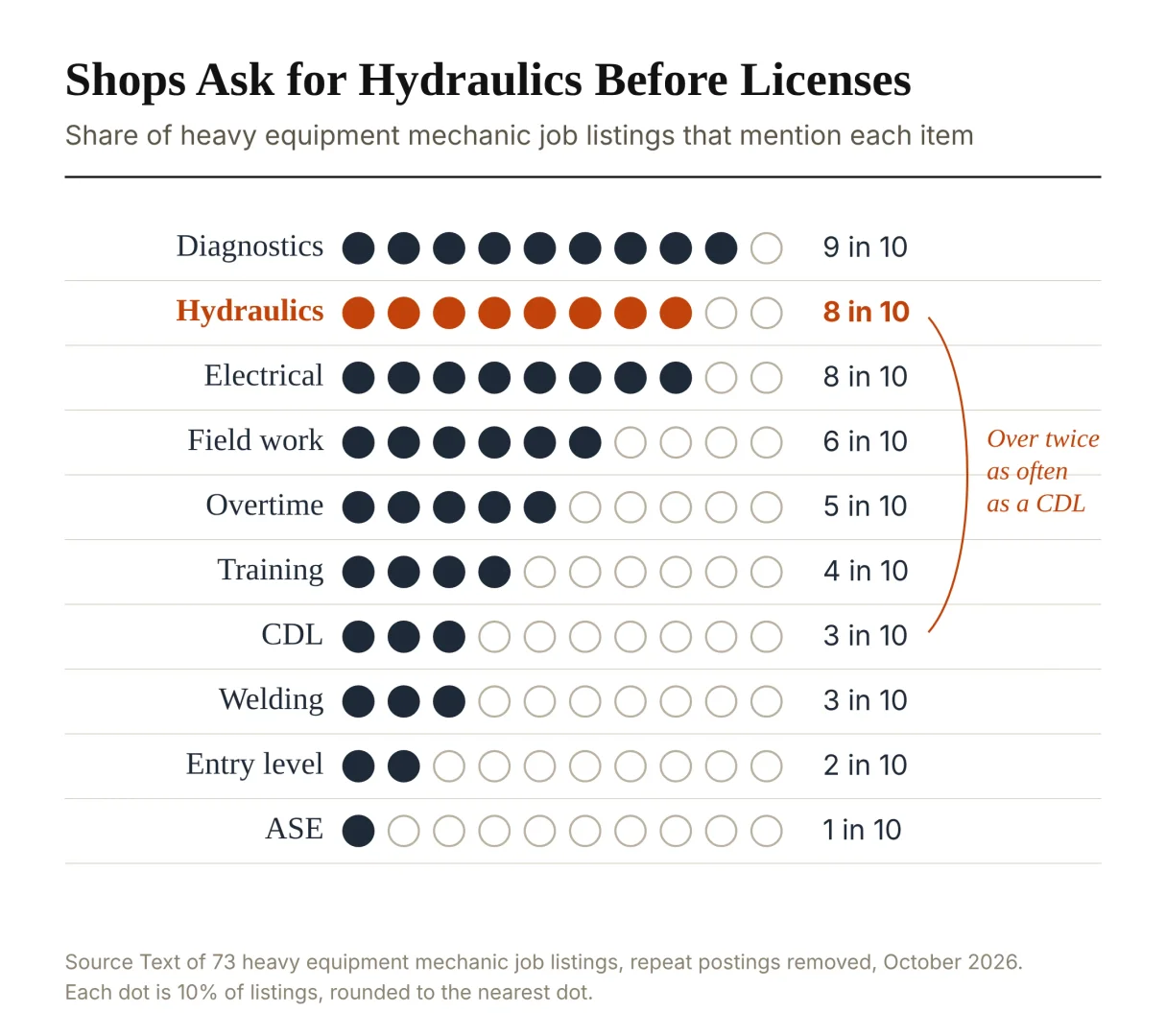
You spend most of your day finding out why a machine stopped working and fixing it before the crew loses more hours. Diagnosis and hydraulics come up in most job listings, well ahead of any license or certificate.
Your week usually mixes these jobs:
- Diagnostics - You plug a laptop into the machine, read fault codes, and trace electrical problems back to a sensor, harness, or controller.
- Hydraulics - You chase leaks, replace hoses and cylinders, and test pumps that lift buckets, booms, and blades.
- Engines and Powertrains - You service and rebuild the diesel engines, transmissions, and final drives that move the machine.
- Undercarriage - You measure and replace tracks, rollers, and sprockets on crawler machines.
- Welding - You repair cracked buckets and frames when the shop does its own fabrication.
Shop or Field?
Expect field work if you want this job. More than half of the listings describe work at job sites or out of a service truck, and the handbook notes that experienced technicians tend to move into field service, with long drives and time outdoors.
Field work means your schedule follows the equipment. Overtime shows up in about half of the listings, and many also mention weekend or on call work. Ask about both in the interview, along with whether the company pays for drive time.
How Is It Different From Truck Work?
You work on hydraulics and undercarriage far more than you would on trucks, and the repairs happen where the machine sits. The pay is close to truck work, as the table shows. The heavy equipment mechanic salary guide breaks that pay down by employer and state, and the heavy equipment mechanic salary page shows the pay ranges employers post.
| Area | Equipment | Trucks |
|---|---|---|
| Main systems | Hydraulics, tracks | Brakes, emissions |
| Where | Job sites | Shop bays |
| Typical pay | $65,510 | $61,770 |
Source: national median pay, May 2025 federal wage data.
How Do You Become a Heavy Equipment Mechanic?
Get formal training first, then use it to land a trainee job at a dealer or rental company. Certificate and associate programs take 1 to 2 years. The handbook calls that training the best preparation for some entry level jobs.
-
Pick a Program - A community college diesel or heavy equipment program works for any employer. Compare costs and placement in the diesel mechanic school guide.
-
Apply to a Dealer Sponsored Program - Equipment brands run programs with their dealers that include paid internships and a job at the end. The table below compares two of them.
-
Budget for Tools - You buy most of your own hand tools, and the program cost sheets below list thousands of dollars for a starting set. Some dealers help with tools for students who agree to work for them.
-
Get Hired as a Trainee - A smaller share of listings accept entry level, trainee, or apprentice applicants. Check construction equipment technician jobs for trainee titles too. The apprenticeship guide shows how to find paid training if school is not an option for you.
-
Plan on a CDL - Some employers want a CDL because you drive a service truck to job sites. The CDL guide covers which class you need.
Dealer Sponsored Programs, Side by Side
The two programs below are examples, one in South Dakota and one in Nebraska. They were picked because each school publishes its full program cost. That lets you see real numbers instead of a range.
You do not need to move to either state. Dealers sponsor students at colleges in other states too. Ask your nearest Cat or Deere dealer which school it works with. The cost column is each school's own estimate for the full program, with tools included.
| Program | Length | Cost | Tools |
|---|---|---|---|
| Cat ThinkBIG | 2 years | $30,698 | $9,250 |
| Deere C&F | 4 terms | $19,869 | $11,000 |
Source: Lake Area Technical College (2026 estimate) and Southeast Community College (current estimate).
The Caterpillar program at Lake Area Tech in South Dakota includes four paid internships at the local Cat dealer, starting at $20.50 an hour. The school values its scholarship and internship package at $35,000 or more.
In return, you commit to working at that dealer for at least 3 years after you graduate. Pick a dealer in a place you want to live.
The John Deere program at Southeast Community College in Nebraska requires a Deere construction dealer to sponsor you before you start. Its graduates report average pay of about $71,100 a year, according to the school. Call the nearest dealer for the brand you want and ask whether they sponsor students. The dealer usually decides who gets a spot.
DieselTechWork earns a commission on some links in this post at no extra cost to you.
What Do Employers Want on Your Resume?
Put hydraulics, electrical diagnosis, and the equipment brands you know at the top of your resume. Those skills show up in far more listings than any certificate. When a listing names a number of years, 2 years is the most common ask, and senior roles tend to ask for 5.
ASE certification shows up rarely, because ASE tests are built around trucks and cars. Manufacturer training carries more weight with equipment dealers. Brand certification "usually commands higher pay," the Bureau of Labor Statistics writes (2026). About 1 in 5 listings name a specific brand such as Caterpillar, John Deere, or Komatsu.
If the job drives a service truck, a Class B license lets you meet that requirement before you apply. You can start with DLA Academy's Class B training while you finish school.
Mining jobs add one more step. Every new miner completes MSHA safety training under federal mine safety rules before working at a mine site. Ask a mining employer whether that training happens before or after your start date.
Browse open heavy equipment mechanic jobs →
Get weekly diesel jobs and salary data delivered to your inbox → Subscribe here
Frequently Asked Questions
How Long Does It Take to Become a Heavy Equipment Mechanic?
Plan on 3 to 4 years to become fully qualified, based on the handbook. School shortens the on the job part, and new hires without school usually get a few months of training before working on their own. Search heavy equipment technician jobs for trainee titles to see who hires beginners near you.
Do Heavy Equipment Mechanics Have to Buy Their Own Tools?
Yes, most heavy equipment mechanics buy their own hand tools and keep adding to them over a career. Only about 1 in 7 listings spell out a tool requirement. Ask the hiring manager what the shop supplies and whether there is a tool allowance.
Is Field Work Harder Than Shop Work?
Field work is harder on your schedule and your body than shop work. You work outdoors in heat and cold, often without the lift or crane a shop would have. Ask whether the field role pays more for that, and compare posted pay on the field mechanic jobs page.
Last updated October 2026.