Updated By
The DieselTechWork Team covers pay, career paths, and hiring for diesel and heavy equipment mechanics. Pay and employment figures come from the U.S. Bureau of Labor Statistics Occupational Employment and Wage Statistics program. Living cost comparisons come from Bureau of Economic Analysis regional price data. Statistics about job listings, such as how often listings ask for a CDL, come from listings posted on DieselTechWork.
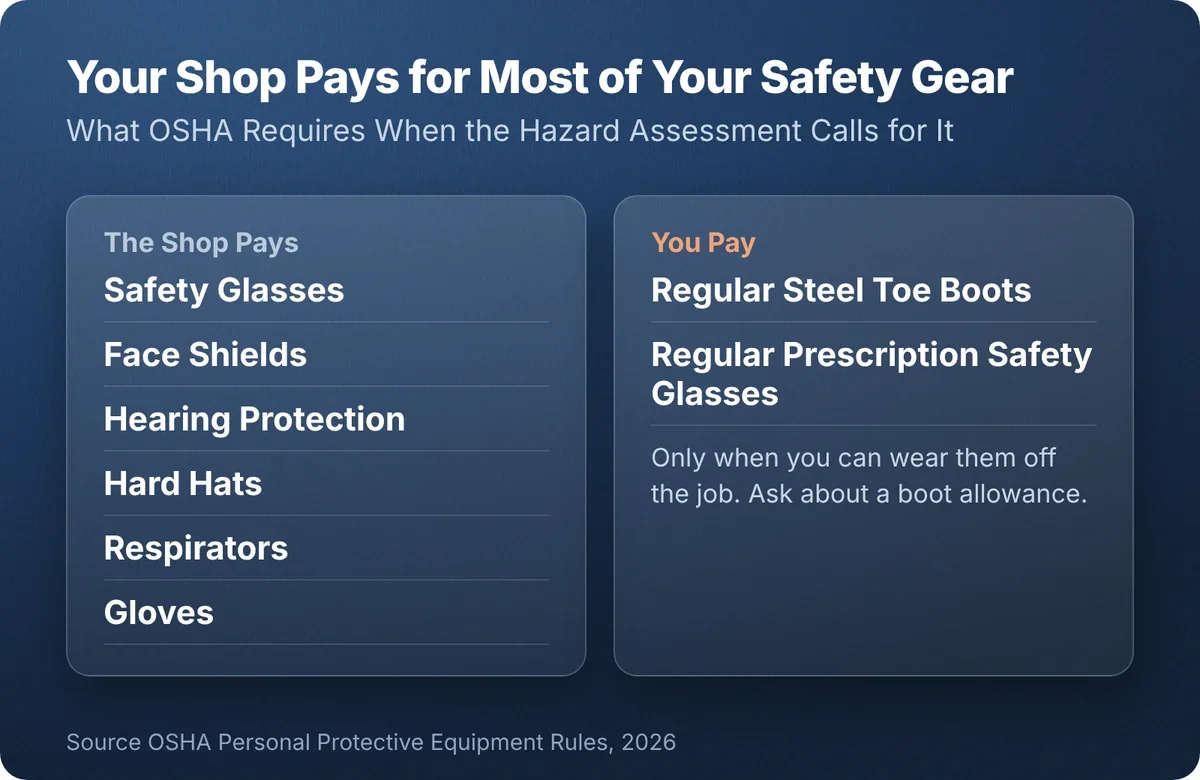
If you work in a diesel repair shop, your employer has to check the shop for hazards and give you the safety gear each hazard requires. Your employer also pays for that gear in almost every case. The two common exceptions are ordinary safety toe boots and ordinary prescription safety glasses. The shop can ask you to buy those when you are allowed to wear them off the job.
These rules come from the general industry standards of the Occupational Safety and Health Administration (OSHA). This is a plain language summary for a new job. The federal text is the final word on each rule. If you are new to the trade, the guide on how to become a diesel mechanic covers training and first jobs.
What PPE Does OSHA Require for Diesel Mechanics?
OSHA requires your employer to assess the shop for hazards and pick protective gear that fits each hazard and fits you. The employer has to certify that assessment in writing with the date and the name of the person who did it. You can ask to see it during your first week.
The same rule requires training on when you need gear and which gear to use. The training also covers how to wear it and what it cannot protect against. If you are coming out of a diesel mechanic school program, expect the shop to train you on its own gear anyway.
Your eye protection needs side shields whenever flying objects are a hazard. Grinding, cutting and air blowing all throw debris. The rule accepts clip on side shields. If you wear prescription lenses, you can use safety glasses with your prescription built in or goggles that fit over your own glasses.
Your employer picks gloves based on the task, how long you do it and the hazards involved. A glove picked for cuts may not stop fuel or solvent from soaking through. Ask which glove the assessment lists for fuel, solvents and sharp edges.
Who Pays for Your Safety Gear?
Your employer pays for required personal protective equipment (PPE) in almost every case. The federal rule says protective gear "shall be provided by the employer at no cost to employees." Employers have had to follow that payment rule since May 2008.
Your employer does not have to pay for non specialty safety toe boots or non specialty prescription safety glasses when you can wear them off the job. You also cover everyday work clothes and weather gear such as winter coats and rain gear. Trainees looking at diesel technician trainee jobs can budget for boots and glasses before the first day.
Ask about a boot allowance before you accept an offer.
When gear wears out, the employer pays to replace it unless you lost it or damaged it on purpose. Outside those exceptions, the shop cannot make you supply or pay for your own required gear. If you are in a paid diesel apprenticeship with a shop, you are its employee and the same payment rule applies.
What Are OSHA's Noise Rules for Diesel Shops?
Impact wrenches, air tools and running engines all add noise in a bay. Noise is measured in decibels with a meter. You will not know the number by ear. If you have to raise your voice to talk with someone an arm's length away, the noise may be loud enough to measure. You can ask whether the shop has run a noise survey.
Once the average over your shift reaches 85 decibels, your employer must run a hearing conservation program. Louder noise cuts the time you are allowed to work in it.
Shift Average | Rule |
|---|---|
85 decibels | Shop must run a hearing program |
90 decibels | Most you can work in is 8 hours |
95 decibels | Most you can work in is 4 hours |
Once a hearing conservation program applies, the rule gives you these protections.
Hearing Protectors · Your employer gives you earplugs or muffs at no cost and replaces them as needed.
Hearing Tests · You get a baseline test at no cost within 6 months of your first loud exposure.
Training · Each worker in the program gets training every year.
Which Other OSHA Rules Apply in a Diesel Shop?
Beyond PPE and noise, the rules you will meet most in a diesel bay cover lockout, chemicals, jacks, forklifts and exhaust.
Topic | Shop Must |
|---|---|
Lockout | Shut off and lock out power before you work |
Chemicals | Label containers and keep safety data sheets |
Jacks | Mark the load rating on every jack |
Forklifts | Check you can drive one safely first |
Eyewash | Put an eyewash station near corrosive chemicals |
Exhaust | Keep carbon monoxide under the legal limit |
Jacks carry two rules you will use on day one. A raised load has to be cribbed, blocked or otherwise secured at once. The jack's rated load must be permanently marked on the jack. Report a jack with a missing or unreadable rating before anyone works under the load.
If you run a forklift in a fleet mechanic shop or parts room, your employer must evaluate your driving at least once every three years. The carbon monoxide limit is 50 parts per million averaged over a full shift. Exhaust hoses on every running engine help keep a bay under that limit.
What Should You Do If Something Looks Unsafe?
A good first step is telling your lead or supervisor and writing down the date you told them. If the problem stays, you can file a confidential complaint with OSHA online, by phone or at a local office. Federal law protects you from retaliation for speaking up. You have 30 days from the retaliation to file a whistleblower complaint.
Some states run their own federally approved safety plans. Of those, 22 State Plans cover private sector workers. Texas has no approved State Plan. Federal OSHA covers private shops there. If your state has its own plan, the state agency's site lists any added rules. When you compare shop technician jobs, ask each shop how it handles its hazard assessment.
Browse open diesel mechanic jobs → Diesel Mechanic Jobs
Get weekly diesel jobs and salary data delivered to your inbox → Subscribe here
Frequently Asked Questions
Can I Use My Own Safety Glasses or Gloves?
Your employer may let you use adequate gear you already own and does not have to pay you back for it. The employer still has to make sure that gear is adequate and kept clean and in good condition. Bring it in and ask before your first shift.
Do Small Shops Have to Follow OSHA Rules?
Yes, small shops follow the same safety rules. A company with 10 or fewer employees all last year does not have to keep injury logs unless OSHA or the Bureau of Labor Statistics tells it to in writing. Every covered employer must still report a death, an amputation, the loss of an eye or an in patient hospital stay.
Does OSHA Require ASE Certification?
No, OSHA sets workplace safety rules and does not certify mechanics. ASE certification is voluntary. The guide on how to get ASE diesel certification covers the tests and costs.
Last updated November 2026