
Updated By
The DieselTechWork Team covers pay, career paths, and hiring for diesel and heavy equipment mechanics. Pay and employment figures come from the U.S. Bureau of Labor Statistics Occupational Employment and Wage Statistics program. Living cost comparisons come from Bureau of Economic Analysis regional price data. Statistics about job listings, such as how often listings ask for a CDL, come from listings posted on DieselTechWork.
Hourly pay gives you the same rate for every hour on the clock. Flat rate pays you the labor time set for each job, whether you finish early or late. The hours you get paid for on finished jobs are called flag hours. Flat rate pays more only when you flag more hours than your break even number. That number depends on the rates in each offer. You can work it out from any two offers with one division.
Hourly pay usually suits newer techs. Flat rate suits fast, experienced techs with steady work. Checking diesel technician pay for your title also tells you whether the base rate in an offer is in line with the market.
How Does Flat Rate Pay Work for Diesel Techs?
Each repair carries a labor time, often called book time or flag time, set by a labor guide or by the shop. You earn that time when you finish the job. If a brake job pays three hours and you finish in two, you get paid for three. If it takes you four, you still get paid for three.
Flag hours come only from finished jobs. Time spent waiting on parts or cleaning the bay may earn nothing unless the shop has a written policy that pays it. Some shops run a hybrid plan with an hourly base plus a bonus for beating book time. RDO Equipment Co. general manager Greg Maurer wrote in 2024 that flat rate is "not a great system for new(er) technicians."
If you are still learning, an hourly trainee spot lets you build speed before your pay depends on it. You can browse diesel technician trainee jobs or read about paid diesel mechanic apprenticeships to see how those programs pay.
How Do the Two Plans Compare Week to Week?
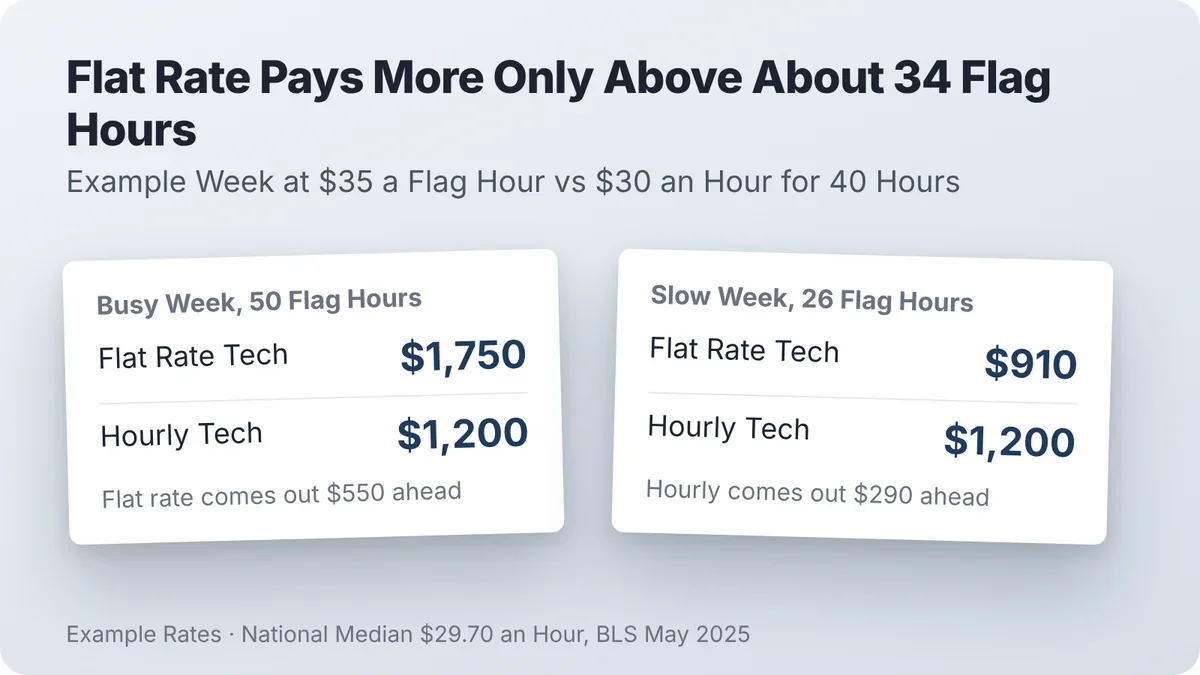
Flat rate pay rises and falls with the shop's workload, while hourly pay stays the same every week. These rates are examples. You can swap in the rates from your own offers.
The example hourly tech earns $30 an hour, close to the national median of $29.70 an hour for diesel technicians, according to the Bureau of Labor Statistics for May 2025.
The flat rate tech earns $35 a flag hour. Both techs work 40 hours on the clock each week. Neither week includes overtime.
Week | Flag Hours | Flat Rate | Hourly |
|---|---|---|---|
Busy | 50 | $1,750 | $1,200 |
Slow | 26 | $910 | $1,200 |
Two Weeks | 76 | $2,660 | $2,400 |
In this example the flat rate tech comes out $260 ahead over two weeks. One more slow week would erase that lead. Base the choice on your average week.
How Do You Find Your Break Even Flag Hours?
You find your break even point by dividing the weekly hourly pay by the flat rate per flag hour. With the example rates, the hourly tech's weekly pay divided by $35 equals about 34 flag hours. If you would flag more than that in most weeks, the flat rate offer pays more.
The service manager knows how many hours techs at the shop actually flag. Ask these questions before you sign.
How many hours do techs at my level flag in an average week?
Is there a guaranteed minimum of paid hours each week?
How are comebacks, warranty work and waiting on parts paid?
Does the flag rate rise with ASE certifications or years at the shop?
If the answer to the last question is yes, the guide on how to get ASE diesel certification covers the tests and costs. You can plug each answer into the break even math and compare the result with the hourly offer you hold.
Does Overtime Law Cover Flat Rate Techs?
Unless an exemption applies, federal wage law protects a flat rate tech the same way it protects an hourly tech. Covered workers who are not exempt must earn at least $7.25 an hour and time and a half after 40 hours in a workweek, according to the U.S. Department of Labor. Federal rules check flat rate pay by dividing your total weekly pay by the hours you actually worked. A higher state or local minimum wage applies where one exists.
One exception can apply if you work at a truck or car dealership. Section 13(b)(10)(A) of the Fair Labor Standards Act exempts from overtime any salesman, partsman or mechanic "primarily engaged in selling or servicing" automobiles, trucks or farm implements at a business that mainly sells those vehicles to the people who use them. The Department of Labor's field operations handbook says the exemption does not cover repair garages that do not mainly sell those vehicles. The handbook also lists trailer mechanics as not exempt.
The Supreme Court applied the same exemption to dealership service advisors in Encino Motorcars v. Navarro in 2018. The 5 to 4 majority opinion by Justice Clarence Thomas held that service advisors are exempt. The exemption removes overtime only. A dealership still owes you the minimum wage for every hour you work.
If you are weighing dealership technician jobs against fleet mechanic jobs, ask each employer in writing whether you will be paid overtime. A dealer flat rate offer with no overtime needs a higher flag rate to match a fleet job where long weeks pay time and a half.
Which Pay Plan Fits Your Next Job?
Hourly is usually the safer choice when you are new to the trade or joining a shop with uneven work. Flat rate can raise your pay once you are fast and the shop keeps a backlog. It works best when your break even number sits well below the hours you expect to flag.
You can compare full offers with the fleet mechanic salary guide and the diesel mechanic salary by state tables. Base pay, overtime rules and your likely flag hours together tell you which offer is stronger.
If you are still planning your path into the trade, the guide on how to become a diesel mechanic covers training and first jobs.
Browse open diesel technician jobs → Diesel Technician Jobs
Get weekly diesel jobs and salary data delivered to your inbox → Subscribe here
Frequently Asked Questions
Do Flat Rate Techs Get Paid for Comebacks?
Comeback pay depends on each shop's written policy. Ask whether a repair you already flagged earns any time when it comes back. A written answer before you accept protects you if a comeback shows up later.
What Is a Guaranteed Hours Plan?
Some shops pay flat rate but guarantee a minimum number of paid hours each week. That floor protects your check in slow weeks and keeps the upside of busy ones. Ask whether the guarantee resets each week or averages over a pay period.
How Can You Track Your Flag Hours?
Keep your own log of each repair order with the hours paid and the hours you actually spent. Comparing the log with your pay stub each week helps you catch mistakes. It also shows you whether you are clearing your break even number.
Last updated November 2026