Updated By
The DieselTechWork Team covers pay, career paths, and hiring for diesel and heavy equipment mechanics. Pay and employment figures come from the U.S. Bureau of Labor Statistics Occupational Employment and Wage Statistics program. Living cost comparisons come from Bureau of Economic Analysis regional price data. Statistics about job listings, such as how often listings ask for a CDL, come from listings posted on DieselTechWork.
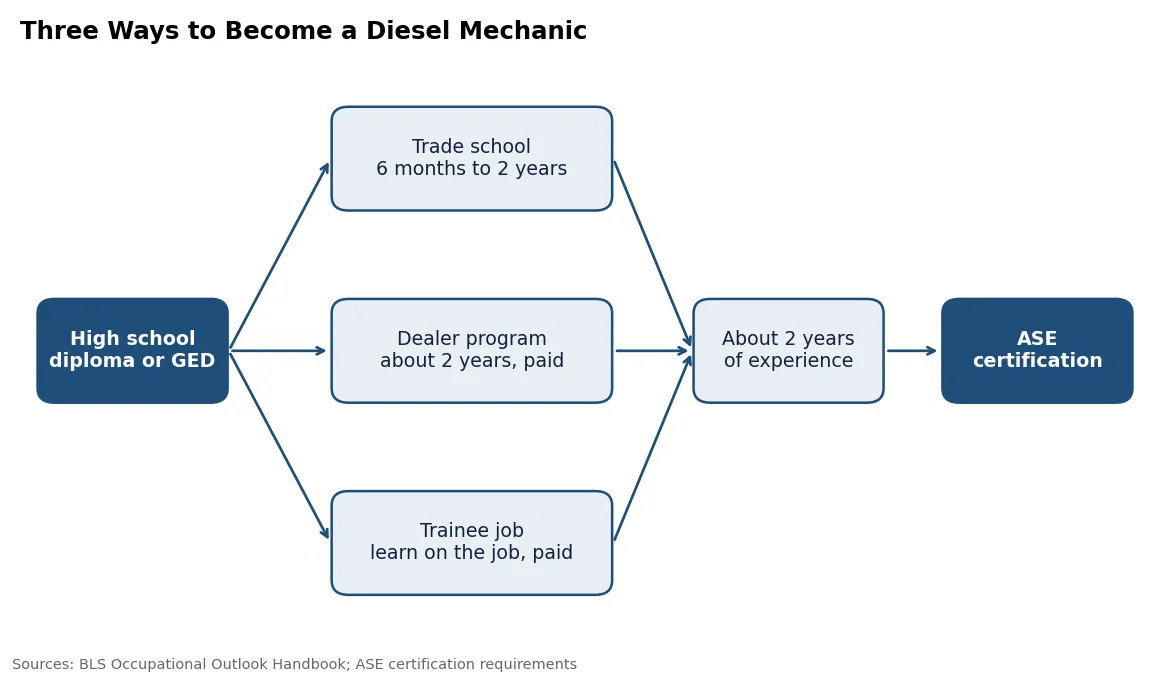
You can become a diesel mechanic with a high school diploma or GED. From there, most people go to trade school, join a dealer sponsored program, or start in a trainee job. All three lead to the same place, about two years of experience and ASE certification. What changes is how soon you get paid and how much the training costs you.
How Long Does It Take to Become a Diesel Mechanic?
It takes anywhere from about 6 months to 4 years, depending on the route.
| Route | Time | Paid? |
|---|---|---|
| Trade School | 6 to 24 months | No |
| Dealer Program | About 2 years | Yes |
| Trainee Job | 3 to 4 years | Yes |
Employers may prefer to hire candidates who have finished a postsecondary diesel program, according to the Bureau of Labor Statistics.
Which Route Should You Take?
If a dealer near you runs a sponsored program, start there. It's the only route that gives you classroom training and a paycheck at the same time.
Dealer Sponsored Program
A dealer hires you, sends you to a partner college, and pays you during work rotations in its shop. Because many dealers cover tuition, you can finish with a degree and little or no debt. Some dealers take applications months before classes start. The diesel mechanic apprenticeship guide walks through how Caterpillar's ThinkBIG program works and when to apply.
Trainee Job
If you need income now, a trainee job gets you paid from the first week. Fleets, truck leasing companies, and dealers hire people with mechanical aptitude and teach them in the shop, starting with inspections and preventive maintenance. Learning everything on the job takes the longest of the three routes. You can see which companies are hiring trainees on the diesel technician trainee jobs page.
Trade School
If you can afford tuition, school is the fastest way to full skill. It also shortens your path to certification, because ASE counts formal training toward its experience requirement.
Do You Need Certifications to Be a Diesel Mechanic?
Not to get hired, but certification raises your pay and opens better jobs once you have some experience behind you.
ASE certification is the standard credential in the trade. You need about two years of experience to certify. You may receive credit for part of the work experience requirement by substituting relevant formal training, according to ASE. The ASE diesel certification guide covers which tests to take first.
A CDL is rarely required to start. About 1 in 50 diesel mechanic job listings require one at hire, and about 1 in 4 prefer one. Shops that prefer it usually want mechanics who can move trucks and run road tests. Check whether you need a CDL for the kind of shop you want before paying for training.
DieselTechWork earns a commission on some links in this post at no extra cost to you.
When you get close to your first ASE test, practice exams show you which areas need more study. Exam Edge offers ASE practice tests for the diesel series.
How Much Will You Earn as You Progress?
Plan on a raise of about $17,000 between your first job and full training. In May 2025 wage data, the lowest paid 10% of diesel mechanics earned about $44,500, the typical diesel mechanic earned about $61,800, and the top 10% earned about $88,700 or more.
Certification is how you move up that range. Once you have two years in and a few ASE tests passed, you compete for jobs in the middle of the range instead of the bottom. Location changes pay too. Typical pay differs by about $33,000 between the highest and lowest paying states, as the diesel mechanic salary guide shows.
Heavy equipment pays the most. Mechanics at equipment dealers and mines earn more than most diesel mechanics, and the heavy equipment mechanic salary guide breaks down who pays the most.
Browse open diesel mechanic jobs →
Get weekly diesel jobs and salary data delivered to your inbox → Subscribe here
Frequently Asked Questions
Is It Hard to Get Hired as a Diesel Mechanic?
No. Total diesel mechanic jobs are expected to grow about 4% through 2035, and federal projections call for about 24,400 openings a year. Hiring stays steady because most openings come from mechanics retiring or leaving the trade. With about 316,000 diesel mechanic jobs nationwide, roughly 1 in 13 opens up every year.
Can an Auto Mechanic Switch to Diesel?
Yes. Your engine, electrical, and diagnostic skills carry over and put you ahead of most beginners. The diesel vs auto mechanic comparison covers what transfers and how pay compares.
How Much Does Diesel Mechanic School Cost?
It varies widely by program, and the diesel mechanic school guide compares the cost of three of them. As one example, Lake Area Tech lists about $27,000 for its ThinkBIG program (2024 to 2025). Apply to dealer sponsored programs before paying your own way. Many of them cover most or all of the cost.
Last updated: October 2026.