Updated By
The DieselTechWork Team covers pay, career paths, and hiring for diesel and heavy equipment mechanics. Pay and employment figures come from the U.S. Bureau of Labor Statistics Occupational Employment and Wage Statistics program. Living cost comparisons come from Bureau of Economic Analysis regional price data. Statistics about job listings, such as how often listings ask for a CDL, come from listings posted on DieselTechWork.
An agriculture mechanic, often called an ag mechanic, keeps tractors, combines, sprayers and planters running for farms and equipment dealers. You can start with a high school diploma or a one year certificate and learn the rest on the job. Farm equipment mechanics earned a median of about $56,550 a year in May 2025, based on federal wage data.
What Does an Ag Mechanic Do All Day?
You find out why a machine quit and get it back to work before the farmer loses a day. O*NET, the federal job database, lists tractors, harvesters, dairy equipment and irrigation systems among the machines you repair. Most weeks mix these jobs:
Tractors - You service engines, transmissions and the hydraulics that lift and power implements.
Combines - You rebuild the threshing and cleaning parts that wear out every harvest.
Sprayers - You fix booms, pumps and the controls that set how much product goes on each acre.
Planters - You repair the seed meters and row units that place each seed.
Precision Ag Systems - You troubleshoot the GPS guidance, auto steer and yield monitors that steer and track each machine.
Precision ag means the electronics that let a machine steer itself and record what it did in each part of the field. Expect a laptop and a wiring diagram to take up as much of your day as a wrench. You also talk to customers a lot, because farmers can usually tell you what the machine did right before it quit.
You keep paperwork too. O*NET lists "Record details of repairs made and parts used" as a core task. Dealers bill the farmer from those notes.
How Much Do Agriculture Mechanics Make?
You will likely earn a little less on farm equipment than on trucks or construction machines. Here is how the median yearly pay compares across the three jobs, where median means half of workers earn more and half earn less.
Job | Median Pay |
|---|---|
Farm Equipment | $56,550 |
Diesel Trucks | $61,770 |
Construction Equipment | $65,510 |
Source: Bureau of Labor Statistics, May 2025.
The gap to construction equipment is about $9,000 a year. If pay is your top goal, compare offers on the heavy equipment mechanic salary page before you commit to one side.
Hourly pay for farm equipment work runs about $27 at the median. Long harvest weeks add to your yearly total only when the employer pays overtime. Many ag employers do not have to pay it under federal law.
How Does the Farm Season Change Your Workload?
Your busy season follows the crop. Spring brings planter and tractor work. Summer brings sprayers and hay equipment. Fall brings combine breakdowns during harvest.
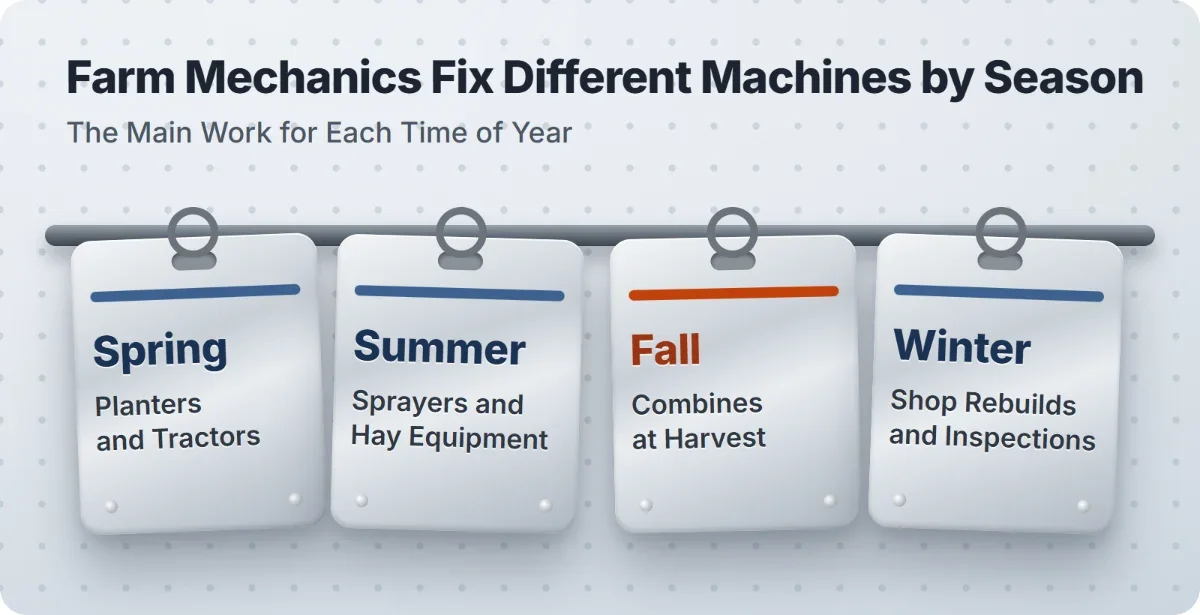
Harvest is the hardest stretch of the year. A combine that quits in the field can cost a farmer a day of good weather. You may get called out early in the morning or late at night. The Bureau of Labor Statistics says most service technicians work full time and "many work evenings and weekends."
Winter is shop season. You tear down and inspect machines before spring, rebuild worn parts and catch up on training. Ask any employer how hours change in the slow months so you know if your paycheck drops after harvest.
Should You Work for a Dealer or a Farm?
Pick a dealer if you want factory training and a steady shop. Pick a farm if you want to work on everything one operation owns and you live near the work.
Compare | Dealer | Farm |
|---|---|---|
Works On | One or two brands | Whatever the farm owns |
Training | Factory courses | Learned on the job |
Customers | Many farms | One operation |
Overtime Law | Dealer exemption | Farm exemption |
Wholesale trade, the federal category that holds equipment dealers, employs more farm equipment mechanics than any other industry according to O*NET. Farms come second. Dealer groups such as Titan Machinery run many stores and move techs between them. You can see current openings on the agricultural equipment mechanic jobs page.
Federal law lets both dealers and farms skip overtime pay for many mechanics. A mechanic who mainly services farm implements at a dealer that sells them is exempt from federal overtime. A worker employed in agriculture on a farm is exempt too. Some states set their own overtime rules. Ask each employer in writing how harvest hours are paid. The flat rate vs hourly pay guide explains how the dealer exemption works.
How Do You Become an Agriculture Mechanic?
You can get hired with a high school diploma and mechanical experience. A certificate opens more doors. About half of the workers O*NET surveyed said a new hire needs a certificate from a school after high school.
Get Basic Training - A one year ag or diesel certificate at a community college covers engines, hydraulics and electrical work. The diesel mechanic school guide shows how to compare programs.
Look at Dealer Programs - John Deere TECH and Case IH Top Tech pair an associate degree with work time at a dealer. You usually need a dealer to sponsor you before you start.
Try an Apprenticeship - The U.S. Department of Labor approves Farm Equipment Mechanic and Technician as a registered apprenticeship title. The diesel mechanic apprenticeship guide explains how those programs pay you while you learn.
Start as a Trainee - Some dealers hire shop helpers and train them on the brand they sell.
Farm kids already have an edge. The diesel technician trainee jobs page lists employers that take beginners. Put the tractors, balers and trucks you kept running on your resume. The diesel mechanic resume guide shows where that experience goes.
DieselTechWork earns a commission on some links in this post at no extra cost to you.
Can Truck or Construction Mechanics Switch to Ag Work?
Yes, your diesel engine, hydraulic and electrical skills carry over to farm machines. Expect to learn the precision ag electronics and the harvest schedule on the job.
The biggest change is the calendar. Construction equipment work runs with the building season, while farm work peaks at planting and harvest. The heavy equipment mechanic career guide covers the construction side if you want to compare the two jobs.
Apply over the winter so you learn the shop before spring planting. If you plan to work for a farm or on your own, you may need your own scan tool. Diesel Laptops sells diagnostic software for agriculture equipment. The diesel mechanic tools list shows what to buy first.
Browse open agricultural equipment mechanic jobs →
Get weekly diesel jobs and salary data delivered to your inbox → Subscribe here
Frequently Asked Questions
Is Ag Mechanic a Good Career?
Yes, demand looks strong. O*NET rates the job a Bright Outlook occupation and expects employment to grow much faster than average through 2035. Your pay will trail construction equipment work. Weigh that gap against the chance to live and work in farm country.
Do Ag Mechanics Travel to Farms?
Yes, many dealers run field service trucks that go to the machine when it breaks down in a field. You may drive long distances in rural areas during harvest. Ask if the job comes with a company truck and how drive time is paid.
Is an Ag Mechanic the Same as a Heavy Equipment Mechanic?
No, federal data counts them as two separate jobs. Heavy equipment mechanics mostly work on dozers, excavators and loaders for construction and mining. Some dealers sell both farm and construction lines. At those stores you may get trained on both.
Can You Become an Ag Mechanic Without Growing Up on a Farm?
Yes, a school program or trainee job can teach you the machines. You will learn faster if you spend time around farm equipment. Ask a dealer about summer or harvest help jobs while you train.
Last updated November 2026.