Updated By
The DieselTechWork Team covers pay, career paths, and hiring for diesel and heavy equipment mechanics. Pay and employment figures come from the U.S. Bureau of Labor Statistics Occupational Employment and Wage Statistics program. Living cost comparisons come from Bureau of Economic Analysis regional price data. Statistics about job listings, such as how often listings ask for a CDL, come from listings posted on DieselTechWork.
A diesel mechanic inspects, diagnoses and repairs machines that run on diesel engines. That covers semis and buses plus bulldozers, tractors, backup generators, locomotives and the engines in boats and ships. The federal O*NET job profile (2026) says the job is to repair trucks and buses or "maintain and repair any type of diesel engines." Typical pay is about $61,770 a year, based on May 2025 federal wage data.
You can start with a high school diploma and learn most of the trade on the job. Your daily work follows the same steps on every machine you touch.
What Are a Diesel Mechanic's Main Duties?
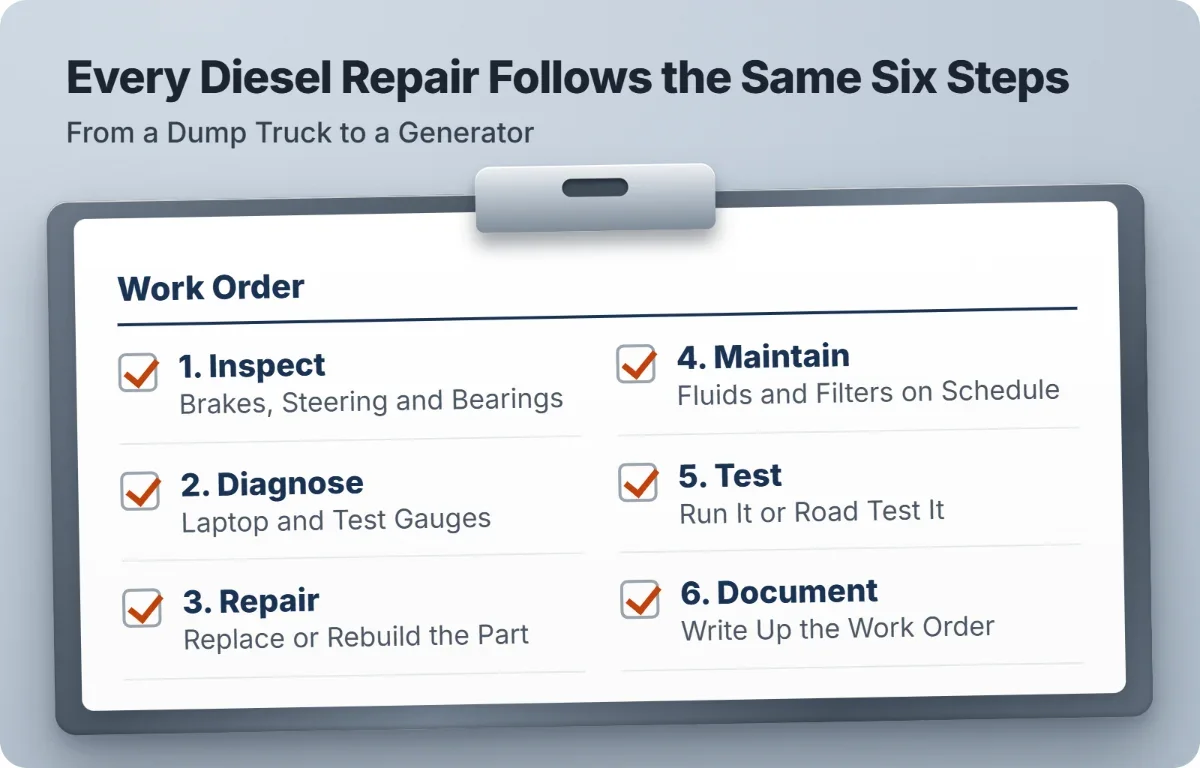
Your main duties stay the same whether the machine in your bay is a dump truck or a generator. Every job runs through these steps:
Inspect - You check brakes, steering, wheel bearings and other wear parts before they fail.
Diagnose - You hook up a laptop or test gauges and track down the cause of a problem.
Repair - You replace or rebuild the failed part, from a small sensor up to a full engine.
Maintain - You change fluids and filters and adjust parts on a set schedule.
Test - You run the machine or road test it to prove the repair worked.
Document - You write up what you found and what you did on the work order, the shop's record of each job.
Diagnosis takes more of your time on newer machines because engines now carry sensors and computer controls. You will lift heavy parts with jacks and hoists too. Employers list these same duties in their postings. The diesel mechanic job description example shows how a hiring shop words them.
Which Machines Do Diesel Mechanics Repair?
You can work on almost anything with a diesel engine. The machine you pick decides which systems you learn best and where you spend your day.
Off road machines lean on hydraulics, the fluid powered systems that lift a loader arm or steer a combine. Generator work includes load tests, where you run the generator under a heavy electrical load to prove it can carry a building through an outage.
Machine | Main Work | Common Employer |
|---|---|---|
Trucks | Brakes and electrical | Fleets and dealers |
Buses | Air brakes and lifts | Transit and schools |
Construction | Hydraulics and tracks | Equipment dealers |
Farm | Hydraulics and engines | Farm dealers |
Generators | Engines and load tests | Power service firms |
Marine | Engines and drives | Boatyards |
Rail | Locomotive engines | Railroads |
Transportation and warehousing companies employ the most diesel mechanics in federal data. Farm and construction equipment mechanics count as a separate group in that data. Your engine and electrical skills carry over between the two. The heavy equipment mechanic career guide covers that side of the trade. The diesel truck mechanic guide walks through a day in a truck shop.
DieselTechWork earns a commission on some links in this post at no extra cost to you.
What Skills Does a Diesel Mechanic Need?
You need to be good at finding the cause of a problem. The O*NET profile lists repairing and troubleshooting first among the skills that carry over to other jobs. Troubleshooting means you test one possible cause at a time until you find the failed part.
You also talk to people all day. Nine in ten workers in the O*NET survey reported face to face discussions every day. You explain repairs to drivers, equipment operators and service writers, the staff who turn your notes into a customer bill.
You will spend part of most days on a laptop. Engine software such as Cummins INSITE reads fault codes, the error messages an engine computer stores when something goes wrong. Most shops supply the diagnostic laptop. If you plan to buy your own for side or mobile work, Diesel Laptops sells diagnostic kits for trucks and equipment. The diesel mechanic tools list shows which hand tools to buy first.
Where Do Diesel Mechanics Work?
You will spend most days in a well ventilated repair shop that can get noisy. Mechanics also "occasionally repair vehicles on roadsides or at worksites," according to the Bureau of Labor Statistics handbook. Field jobs on construction, farm and generator equipment put you in a service truck far more often.
Expect grease, fumes and dirt every day. In the O*NET survey, 85% of diesel mechanics said they face contaminants daily. Most also wear safety glasses, gloves and hearing protection on every shift.
Most diesel mechanics work full time and some put in more than 40 hours a week. You usually get set schedules at company fleets, transit agencies and city garages. The guide to fleet mechanic jobs explains how those shops run. Dealers and independent shops give you a wider mix of jobs.
Where Can a Diesel Mechanic Job Lead?
You can stay on the tools for your whole career or move into a lead or management role. The median diesel mechanic earned $61,770 a year in May 2025. That works out to about $29.70 an hour. New mechanics usually start below that figure and move up with experience. You can check posted pay on the diesel mechanic salary page.
About 24,400 openings are projected each year over the next decade. Many of them will come from mechanics who retire or leave the trade. Experienced mechanics who want a change often move into one of these roles:
Lead Technician - You take the hardest diagnostic jobs and train newer mechanics.
Shop Foreman or Service Manager - You assign work, check finished repairs and deal with customers.
Field Service Technician - You drive a service truck to machines on farms and job sites.
Mobile Business Owner - You run your own service truck and set your own rates, as the mobile diesel business guide describes.
ASE certifications are the standard proof of skill in the trade. Many lead technician postings ask for them. The ASE diesel certification guide lists the tests for trucks and buses.
Browse open diesel mechanic jobs →
Get weekly diesel jobs and salary data delivered to your inbox → Subscribe here
Frequently Asked Questions
Is a Diesel Technician the Same as a Diesel Mechanic?
Yes, the two titles describe the same job in federal data. O*NET lists Diesel Mechanic, Diesel Technician, Bus Mechanic and Transit Mechanic among the titles workers report. The diesel technician vs diesel mechanic guide shows how employers use each one. You can browse diesel technician jobs next to mechanic openings.
Do You Need a Degree to Be a Diesel Mechanic?
No, most new hires get in without a degree. In O*NET survey answers, 39% said new hires need a postsecondary certificate and 37% said a high school diploma is enough. The guide to becoming a diesel mechanic compares school, dealer programs and trainee jobs.
Do Diesel Mechanics Drive the Machines They Fix?
Yes, you will often move trucks around the yard and road test your repairs. O*NET lists operating vehicles and equipment among the top work activities in the job. Some employers want a CDL so you can take a truck out on public roads.
Last updated November 2026.